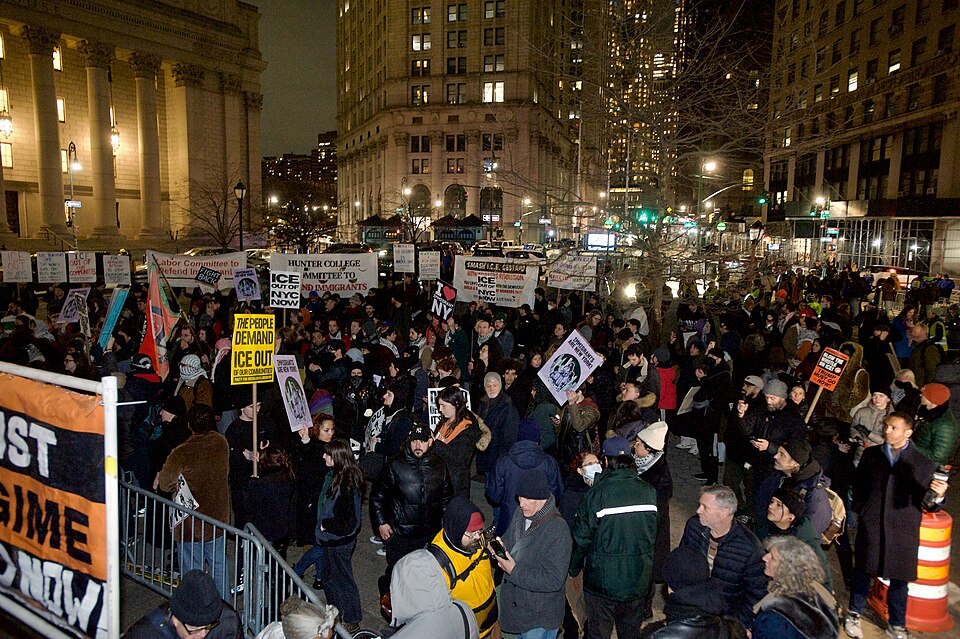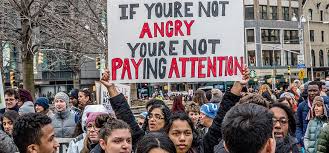

Over the past decade, our country—but more specifically, New York City—has seen rising division and polarization in almost every political race. Many voters are left contemplating how this divide has been reflected in NYC, a place with a longstanding reputation as a haven for liberal and progressive ideas.
Since its founding, our city has been a melting pot of diverse cultures, languages, and beliefs, yet one may wonder how that plays out in our political climate today.
Soon, the registered voters of New York City will have yet another opportunity to have their voices heard, as we embark on the election for our city’s 111th mayor.
Currently, the three leading candidates in the upcoming mayoral election are Democratic nominee Zohran Mamdani, followed by Independent Andrew Cuomo, and Republican nominee Curtis Sliwa. Each candidate offers vastly different views on an array of issues affecting our city, country, and role in global politics. To make informed decisions about candidates, it is vital to understand where each stands on key issues.

Zohran Mamdani has gained popularity and brand recognition, making daily headlines and attracting significant attention. However, one might ask: Who IS Zohran Mamdani? What is his political background?
According to his official campaign site, current New York State Assemblyman Mamdani’s key policies and beliefs are as follows:
- “Freeze the rent.” Mamdani plans to use his power as mayor to bring down housing costs and create a more affordable city.
- “Invest in citywide mental health programs and crisis response.” Mamdani plans on creating a safer city by deploying social workers in order to maintain safety.
- One of Mamdani’s most prominent policies is his plan to make buses “fast and free.”
- As a Democratic Socialist, Mamdani advocates for creating city-owned grocery stores to keep prices low.
- Mamdani is fighting for low-cost childcare, ensuring that all New York families have access to quality care and aren’t driven out of the city by rising costs.

Arguably, Mamdani’s top competitor is former New York State Gov. Andrew Cuomo, who had a rocky experience during his tenure. While Cuomo started with immense support, especially during the early months of the pandemic, he eventually resigned with an extremely low approval rating due to multiple scandals. Cuomo’s run for mayor as an Independent candidate is his attempt to stage a political comeback, and many back him as an experienced politician. While he lost the Democratic primary to Mamdani, he remains steadfast in his fight to become New York City’s next mayor
According to Cuomo’s official campaign site, his core beliefs and policies are as follows:
- Cuomo has long advocated for a better education for New York City’s 900K students. If elected, Cuomo plans to reduce class sizes and improve community engagement with schools.
- Cuomo acknowledges the affordability barriers that New Yorkers face. To combat this, he plans on “addressing housing, childcare, health, transportation, economic development, and job creation.”
- “A safe New York City will be a top priority of the Cuomo Administration.” He plans to increase the NYPD’s size and budget.
- Cuomo calls for accelerating affordable housing construction while ensuring quality.
- One of his most popular policies is that of combating all forms of hate with legal force, especially fighting to decrease racism, antisemitism, Islamophobia, and homophobia in New York today.

Curtis Sliwa, a longtime activist, founder of the Guardian Angels and Conservative radio talk show host is running for mayor again after losing in the 2021 election. He is backed mainly by Republican and moderate voters. Sliwa has gained attention for performing well during the debates and having a notable social media presence.
Sliwa is running on a platform that advocates for:
- “Public Safety for all.” Sliwa plans to do this by hiring around 7000 additional NYPD Officers
- Like the other candidates, Sliwa plans to fight hard for an affordable city. One of his main plans to tackle this is to “Restore NYC’s 28,000+ Vacant Rent-Controlled Apartments.”
- Sliwa plans to “reform the DOE [Department of Education] and restore accountability,” fighting to make schools “safe and supportive.”
- Sliwa wants to clean up the city, including its streets and public spaces.
- For a long time, Sliwa has advocated for improving conditions on Rikers Island and instilling “safety and order” in all NYC Jails.
Last week, a survey was sent to the iSchool community to gather information on the mayoral race and candidates. Respondents included 33 students, 18 parents/guardians, four faculty members, and one unspecified responder. Of the 56 respondents, 43 would cast a vote for Mamdani, eight for Cuomo, one for Sliwa, three for “unsure,” and one for “other. ” Overwhelmingly, our community favors Mamdani by a significant margin.
Of the respondents, 94.6% said they plan to vote or would vote if they were 18 or older. This is in stark contrast to the 2021 Mayoral Election, when approximately 23.4% of eligible voters turned out, or nearly 13.6% of NYC’s total population. Out of the faculty who filled out the survey, 100% said that Mamdani “most aligned with their political views,” followed by 76% of students, and 72% of parents/guardians.
87.5% of respondents considered themselves well-educated on this matter, which is quite representative of the explosion of interest in NYC mayoral politics, particularly during this election cycle. As for what survey respondents had to say on the upcoming election, many praised Mamdani for “interacting with New Yorkers,” his efforts “[to defund] the police department,” his plans for “free buses, free childcare, [building] 200k new subsidized housing units,” as well as his “innovative and smart” character.
Multiple respondents criticized Mamdani; however, 37.5% said they would reluctantly vote for him, arguing that he was the best of three undesirable options. Some respondents said they were reluctant to vote for him due to his “unrealistic proposals,” “anti-gifted & talented” policies, and “lack of real experience.” One response criticized him for “already [having] been elected to office (assembly) and [proving] he can’t do the job.”
Additionally, multiple respondents brought up the fact that Mamdani has been very vocal on the current situation pertaining to Israel and Palestine, with some stating that Mamdani has “not denounced Hamas, in a city with the largest Jewish population outside of Israel.” Additionally, some have called him a “giant antisemite” and criticized him for his “history of anti-Israel and often anti-Jewish associations.” On the other hand, one faculty member at the iSchool says, “I don’t like the backlash that Mamdani is getting for being against Israel’s actions against Palestine. He’s right!!”
As for what respondents had to say about Cuomo, one mentioned that “the allegations that led to Cuomo’s resignation in 2022 are very concerning.” Additionally, one criticizes Cuomo due to him “[aligning] with Donald Trump and [having] a terrible governorship.”
A deeper dive into the anonymously collected data from the iSchool community survey is available (note that this is only open to members of the iSchool community with an officially registered email).
Despite being unable to vote, our student community is working to stay engaged. On Tuesday, October 21st, iSchool Juniors Adriana Esposito, Zachary Leitner, and Hazel Ward held their second voter registration drive in the school lobby, assisting 50 students in registering or pre-registering to vote. This drive was non-partisan and didn’t advocate for any specific candidates. Rather, the goal was to get students excited about voting and civic engagement.
Adriana thinks “voting is one of the most integral aspects of a democratic society… By holding a voter registration drive, we helped ensure that students knew that they too could have a say in politics. She argues that “getting the youth involved, whether simply educating them on the upcoming election or registering them to vote, sets a precedent of hopeful change in our future.”
Hazel says that she is “thrilled to vote since [she] feels very strongly about politics, like many of [her] peers.” She says, “voting gives us a voice and empowers us to use that voice for change.”
As early voting began on October 25, the city saw a record number of early voters. With almost every recent poll predicting a victory for Mamdani by a margin of 10-20%, many New Yorkers are anticipating a New York City under ‘Mayor Mamdani.’ However, Andrew Cuomo and Curtis Sliwa are both ‘in it to win it’ and are actively campaigning across the boroughs.

It is undeniable that the future of New York City will be marked by change, including new policies, reforms, and ideas. It is vital to research each candidate using credible sources and make your own determination of who you believe is the best fit to represent our city as its next mayor.
As a reminder, early voting has already begun, and Election Day is November 4th, with polls opening at 6 AM and closing at 9 PM. For more information on how to vote, why you should vote, who’s on the ballot and how to get involved, please visit NYC Votes. Don’t forget to flip your ballot to the second page and pay special attention to the six ballot proposals (sometimes called ballot measures) that address the city’s charter reforms.