

TW: Discussions on eating disorders, depression, body dysmorphia, and negative behaviors.
Imagine this, you’re scrolling on TikTok mindlessly until a video pops up on your #ForYou Page – a video on “thinspiration”. The video includes numerous photos of skinny girls – some almost just skin and bones. Lana Del Rey’s unreleased satire song, “Boarding School,” plays in the video with the lines of “I’m a fan of pro-ana nation. I do them drugs to stop the f-food cravings” (“Boarding School, 0:35-0:44). You might question, “Why was this video even made?”
Toxicity in Girl World, also known as “Feminine Toxicity,” includes many issues and topics like romanticizing mental illnesses (ex: eating disorders or depression), manipulation, harmful beliefs and promotion, and many other serious topics/issues. Femcels, female manipulators, and some girlbloggers have at least one of these demeanors.
The rise of toxic femininity has been increasing on social media for a few years now. Not many sources know in-depth details about all these new labels and subcultures on the internet, but it’s known that these communities can be harmful to society. Femcels openly promote and talk about their feelings rooted in involuntary celibacy, female manipulators love to be “mentally insane”, and some girlbloggers promote and romanticize eating disorders. This article will be an in-depth analysis of them.
Femcels: Who Are They, and Where Did They Come From?
The noun femcel was created when a subculture online wanted a name for female incels – hence the name femcel, a portmanteau of female incel. “Why can’t these girls just call themselves incels?”, you may ask. The noun incel was created by a Canadian University student in the 90s who goes by the name Alana. Alana created a website called “Alana’s Involuntary Celibacy Project,” which was a forum and blog that allowed people to talk about the struggles of finding relationships and being lonely.
This website was originally made for all genders – although this changed when Alana had stopped paying attention to her website, handing it over to another member because her dating life was going well. Alana’s website and noun had been taken over by many misogynists and mostly toxic men as they started to blame women for their celibacy – this issue has made society think that the noun incel was only towards men.
Femcels started emerging on the internet around 2018, thus to the lack of information there is on them. When Wall Street’s Michael Nip was asked if femcel behavior was a thing when he was younger, he stated, “Women weren’t really focused on because men had more power than women, so the label femcels didn’t exist in my day because there were only male chauvinists and in the 70s, but people didn’t consider women so much.”
Although these labels are new to the world, these types of behaviors have been around for ages in both men and women. It might not have been clearly noticeable that women might have acted this way decades ago, but it is almost impossible that a female has felt these emotions similar to a femcel.
Both incels and femcels believe that they are unable to achieve sexual activities and that they cannot find a relationship, mostly because of their looks and the belief in fatalism. While incels tend to blame women for being unable to attract females, femcels blame themselves and their looks for not being able to achieve a relationship. Though their beliefs are similar, many people can say that their demeanors are different.
Many incels are known to be misogynistic, violent, and sometimes homophobic, while femcels are found to not have violent behavior and they don’t gender-hate. Many femcels would use blogs and forum websites to promote femcels and to find other femcels to relate to. Reddit was a big forum community for femcels. Specifically femcels would use r/TruFemcels to promote the idea of femcels until Reddit banned this forum in January of 2021. r/Vindicta – a Reddit form that is still in use, was created by femcels that focuses on tips for femcels on how to become prettier.
Fleabag from the 2016 drama series, Fleabag, has been an inspiration for femcels. Why? The TV series Fleabag’s plot follows a female who is having trouble finding a relationship while also coping with her trauma – similar experiences femcels might have, right?
However, some people can argue that Fleabag isn’t actually a femcel. According to YouTube commentator Broey Dischanel’s video essay “Fleabag is Not a Femcel”, Dischanel explains that Fleabag is not a femcel because Fleabag’s detachment from the world is a way to hide her deep emotional trauma, which is not rooted in involuntary celibacy.
Yes, Fleabag and femcels might have difficulty in finding a relationship, but that does not make Fleabag an actual femcel.
The number of femcels and femcel communities online is growing more and more, especially because platforms like Reddit keep banning these types of forums/ communities. Femcel-core, on the other hand, is similar yet different compared to femcels.
Femcel-core: Differences Between Femcels and Femcel-core
So what is “femcel-core”? Femcel-core is the aesthetic of femcels – or just what people think femcels like. This aesthetic includes sad girl aesthetic, 2014 grunge Tumblr, anime from the 1990s-2000s, and similar interests that a female manipulator might enjoy. Although this aesthetic is linked to femcels, people on platforms like TikTok have been ironically participating in this aesthetic and ridiculing it by mockery and sarcasm.
When “femcel-core starter pack” is searched up on Pinterest, you will most likely find books, movies, artists, and interests bunched up in one photo – creating a portfolio, or “starter pack” of things that a femcel might like. Artists like Lana Del Rey, Fiona Apple, Mitski and even American poet and author Sylvia Plath have been dragged into this aesthetic because of their “sad girl” type of performance.
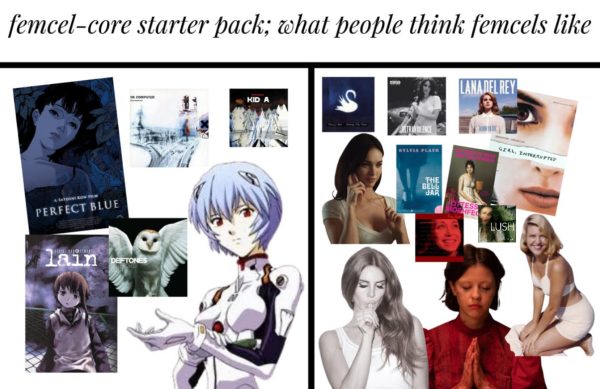
Glamour Magazine’s article “What are femcels? The truth about the internet subculture” explains that the average idea of femcel-core is “a home stacked with books like The Virgin Suicides and The Bell Jar; it’s catholic iconography as an alt-trad ‘look’ rather than a religion; it’s even ‘toxic femininity’ – and being totally okay with that status.”
Of course, simply enjoying all these things doesn’t make someone an actual femcel – this is where the irony comes from for this online aesthetic appeal. Some online pretend that their aesthetic is femcel-core just to ‘ragebait’ people. Some online do just tend to mock how femcels are in their “messy era” 24/7.
While femcels’ emotions can be considered a cry for help, femcel-core and people who partake in this aesthetic tend to have that performative behavior of being dissociated from people and the world around them – the behavior of being different and “niche” from others.
While femcel-core often centers around isolation and self-pity, another aesthetic and label is beginning to emerge on the internet – one that is the complete opposite of femcel-core, as it includes: manipulation, confidence, and control. This is the rise of female manipulators.
Female Manipulators: Pretty, Poisonous, and Powerful
YouTube commentator Mina Lei’s video essay ‘“toxic” femininity: what’s up with girlbloggers, female manipulators, and femcels?’ explains the toxic teen-girlhood aesthetics on the internet, specifically focusing on femcels and female manipulators. The video essay has gone viral and has sparked many opinions about how online subcultures and aesthetics portray females who embrace manipulation or a self-aware feminine image.
A female manipulator is often described as a woman who manipulates people by using emotional tactics, especially in relationships or social contexts. A female manipulator usually participates in love-bombing by giving intense affection and attention to someone before gaining control over their emotions, gaslighting, and guilt-tripping. These traits are usually mirrored by a female villain they idolize.
Female manipulators have been both romanticized and criticized; some view this persona as a way to messily empower over people and to become that true “mentally insane” female, while others view this as pure toxic behavior.
Jasmine Ortiz, a freshman at NYC iSchool, shared her opinions on female manipulators in an interview: “I mean, I feel like female manipulators are not the best because manipulation towards people can be very harmful towards them.” Her statement reflects a general criticism that romanticizing manipulative traits can normalize unhealthy behaviors.
Amy Dunne from the 2012 novel and 2014 film Gone Girl is often known to be one of the biggest inspirations for female manipulators. Dunne’s behaviors in Gone Girl can be defined by her intelligence, emotional manipulation, and desire for control. Through her manipulation and lies, she exposes the expectations placed on females while weaponizing them for revenge, making her the ultimate example of a “female manipulator”
In recent years, the “female manipulator” persona has spread widely across social media platforms like TikTok and Tumblr, where users post and share clips, quotes, and aesthetics inspired by Amy Dunne’s “cool girl” monologue, Lana Del Rey’s lyrics, and the classic femme fatale aesthetic. This online trend is often either critiqued or admired – some users adopt this label as their identity, while some other users online use it ironically, just like how some people used the femcel-core aesthetic.
The popularity of this aesthetic reflects how internet culture can turn serious emotional behaviors into romanticized trends, exposing a cultural fascination with flawed yet powerful women who redefine what it means to be feminine.
While the female manipulator persona’s main idea is control and emotional power, Girlbloggers explores a softer but equally performative and toxic side of femininity online.
Girlbloggers: Romanticizing Pain Through Rose-Colored Glasses
“La Vi en Rose. It is the French way of saying, ‘I am looking at the world through rose-colored glasses.’” – Audrey Hepburn, Sabrina (1954)
Girlbloggers are part of an online subculture that emerged from platforms like Tumblr and TikTok – specifically, 2010’s Tumblr was known to have a “sad girl” aesthetic which included movies like The Virgin Suicides, Girl Interrupted, Black Swan, and artists like Lana Del Rey, Lorde, and Mitski. Girlbloggers are often young females who express their emotions and identities through a curated aesthetic. Their content often includes 2022 coquette, poetry, vintage music and fashion, and melancholic music like Lana Del Rey and Mazzy Star. Their aesthetic tends to also include self-reflection and fragility. On the surface, girlbloggers express sensitivity and creativity – but beneath the beauty for some girlbloggers, lies a darker idealization of pain, sadness, and even mental illnesses like depression, body dysmorphia, and disordered eating. Many posts turn mental illnesses into something poetic and desirable, creating a community where emotional suffering is both shared and romanticized.
In many communities on the internet, mental illnesses have been quietly transforming into an aesthetic rather than a serious problem. In girlblogger communities, disorders such as eating disorders, body dysmorphia, and depression are often romanticized through pro-tips, aesthetic imagery, and poetic quotes. Some posts posted by girlbloggers on “thinspiration” and pro-ana tips are made to look beautiful rather than harmful and toxic, turning suffering into something that some people desire. These types of posts blur the line between self-destruction and self-expression. Though a post on anorexic “thinspiration” might not be intended to promote eating disorders, the endless cycle of delicate sadness turns pain into beauty, making the idea of recovery and healing seem bland next to the tempting, beautiful packaged misery.
Some girlbloggers romanticize their mental illnesses as a way to cope; they turn their struggles into something they can control, something that they can make it seemingly beautiful. By making their mental illness issues seem elegant and lovely, these girlbloggers create distance from their challenging emotions and instead find people to connect with who do the same thing – romanticizing mental illnesses/disorders.
Ethan Nip, a student at Stony Brook University was asked if it was reasonable when people justify and romanticize their issues to cope Ethan Nip stated: “People should not romanticize illnesses because in reality they are horrifying, for example on Twitter there’s a whole community for self harm and eating disorders – this doesn’t make them feel better it only justifies their actions, justifying your mental health makes it even worse.”
The normalization of romanticized mental illnesses in online communities can ultimately turn suffering into something desirable, aesthetic, and even aspirational. This not only distorts the reality of these dangerous conditions but also makes recovery seem less appealing than staying unwell. These girlbloggers, intentionally or not, have created an online culture where illnesses are worn like an accessory – where sadness is stylized, but healing is rarely shown.
The majority of girlbloggers turn their social media platforms into something creative and stylish, but it can become dangerous when some girlbloggers distort mental illnesses into a lifestyle and aesthetic. In a digital age where identity is often shaped online – especially with young children online, it’s important that communities and platforms have spaces that validate pain without glorifying it – because there is nothing beautiful and graceful about staying unwell.
Toxic femininity overall is everywhere. The rise of femcels, female manipulators, and girlbloggers reveals how internet culture has shaped a new wave of femininity – one that is complex and sometimes deeply toxic. All these personas may be a beginning for someone’s escape from mental and emotional issues – but when they turn into trends, aesthetics, and/or identities, they risk normalizing emotional suffering and harmful behaviors. Self-expression is an important thing for everyone, but it can become dangerous when pain is painted as a beautiful thing that people desire to wear like a medal.
As these subcultures continue to gain popularity online, especially among young users, it’s essential to critically examine the messages these communities send. While trends and aesthetics can be beautiful, some trends and aesthetics might not always be beneficial to follow. At some point, we have to ask: Are these girls really being seen – or are they just being watched?